

What Does It Mean to Be Kinder to Yourself?

Have you ever noticed how much easier it can be to show kindness to someone else than to yourself?
When a friend is struggling, makes a mistake or feels like they are not good enough, we usually respond with patience and understanding. We might remind them that everyone has difficult moments and offer some support.
But when we are the one struggling, the response can be very different.
Our inner critic can quickly take over, saying things like:
“I should have handled that better.”
“Why can’t I get this right?”
“Everyone else seems to be coping better than me.”
So, how can we respond differently when our inner critic shows up? This is where self-compassion comes in.
What is self-compassion?
Self-compassion means showing yourself the same care and understanding you would offer someone else. Compassion (or “suffering with” from its Latin root) means we notice someone else’s suffering or their negative feelings about themselves. When we see someone suffering or struggling, we often respond with kindness, mindfulness and common humanity. We recognise that mistakes, disappointment and difficult feelings are a normal part of life. We listen with care, offer support and remind them that they are not alone.
Self-compassion is about turning that same kindness inward.
Most of us have an inner critic which is a harsh, judgmental (sometimes cruel) voice providing a running commentary on what we do- especially when we make mistakes! Through this inner critic, we think things about ourselves we would never think about someone else (let alone say to them out loud). Self-compassion can be a useful tool to quiet your inner critic.
How can we show ourselves support, comfort and care when we’re feeling inadequate or when we’ve made a mistake?
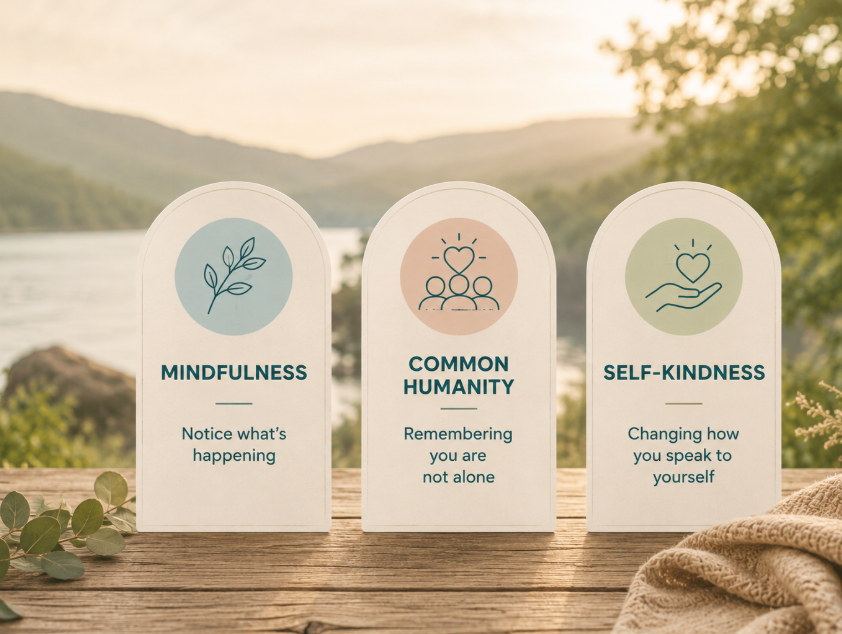
The 3 pillars of self-compassion:
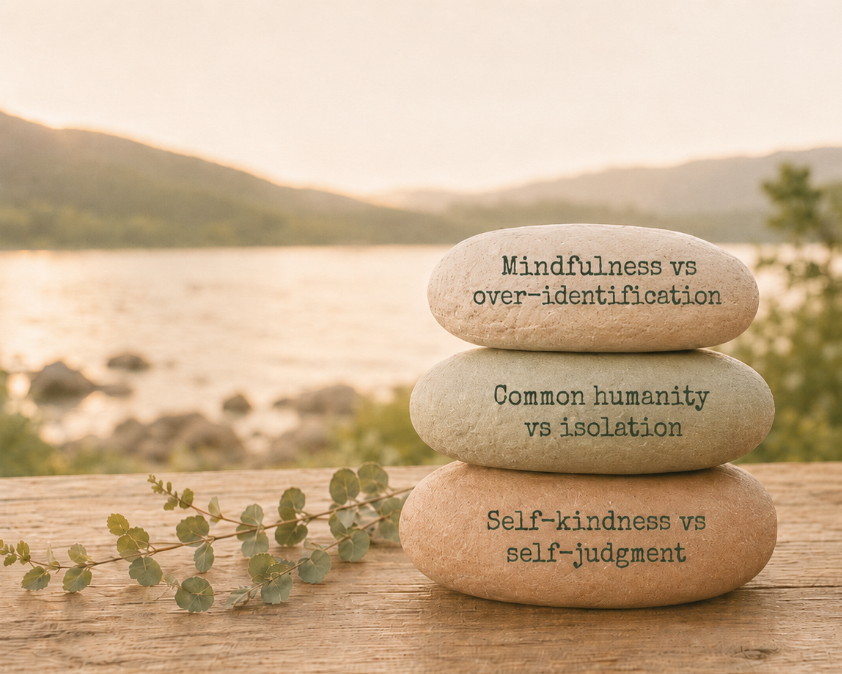
Mindfulness vs over-identification:
Self-compassion begins with mindfulness. It’s about pausing and noticing what we are thinking and feeling without judging ourselves or becoming overwhelmed by it.
By gently turning toward difficult thoughts and emotions with openness and acceptance, we can recognise what we are experiencing without becoming consumed by it. Rather than “over-identifying” with the self-criticism or being swept up in the emotional overwhelm.
Instead of saying: “I’m a failure.”
We might say: “I’m feeling disappointed because this didn’t go the way I hoped.”
This helps us recognise that we are having a difficult experience without letting it define us. We can acknowledge that something hurts without minimising it or telling ourselves to “get over it.” Mindfulness creates a little space between what we are feeling and how we respond, allowing us to meet ourselves with greater kindness, perspective and understanding.
Common humanity vs isolation:
When life feels difficult or we make mistakes, it’s easy to believe we’re alone in our struggles. Many people experience a quiet sense of isolation.
We may find ourselves thinking: “Why am I the only one finding this so hard?”
The truth is that everyone struggles. Every person experiences pain, disappointment, setbacks and moments of self-doubt. Our circumstances may be different, but difficulty and imperfection are part of being human. Remembering this can help us feel less isolated or ashamed.
Self-compassion allows us to say: “This is difficult, but I am not the only person who has felt this way.”
Practising self-compassion doesn’t mean ignoring mistakes or avoiding responsibility. It means responding to ourselves with kindness and understanding, while remembering that struggling is something we all experience.
Self-kindness vs self-judgment:
Self-kindness means responding to yourself with care rather than criticism. This does not mean making excuses or telling yourself that your actions do not matter. It means choosing words that help you feel supported enough to cope, learn and make changes.
You might ask yourself: “What would I say to a friend who was going through this?”
Then try offering some of those same words to yourself.
Instead of saying: “I always mess things up.”
You could try: “I made a mistake, and I can learn from it.”
Speaking to ourselves in a gentle and encouraging way helps us to feel safe and allows us to better cope with challenges or make the changes we want to see in our lives.
Simple Ways to Practise Self-Compassion
Self-compassion is something we can practise in small, everyday ways:
Speak to yourself like you would a friend.
Journal about your human imperfections with acceptance.
Challenge your inner critic by reframing its observations in a kinder way.
Increase self-soothing e.g. get a massage, do your nails, call a friend to chat, go out for a nice meal, cook yourself a nice meal, sing, hug a pet.
Make self-care a non-negotiable part of your routine.
Pick a soothing sentence to repeat to yourself e.g. “I am enough just as I am”, “I belong”
Dr. Kristin Neff’s work on self-compassion is a great resource to explore. She has a self-compassion quiz on her website you can take to see how you score!
Working with a mental health professional can help you identify your inner critic as well as develop self-compassion skills in order to treat yourself with the kindness you deserve!
Written by Marion Thomas (Registered Counsellor)