

Your brain’s alarm system: Anxiety, trauma, and survival
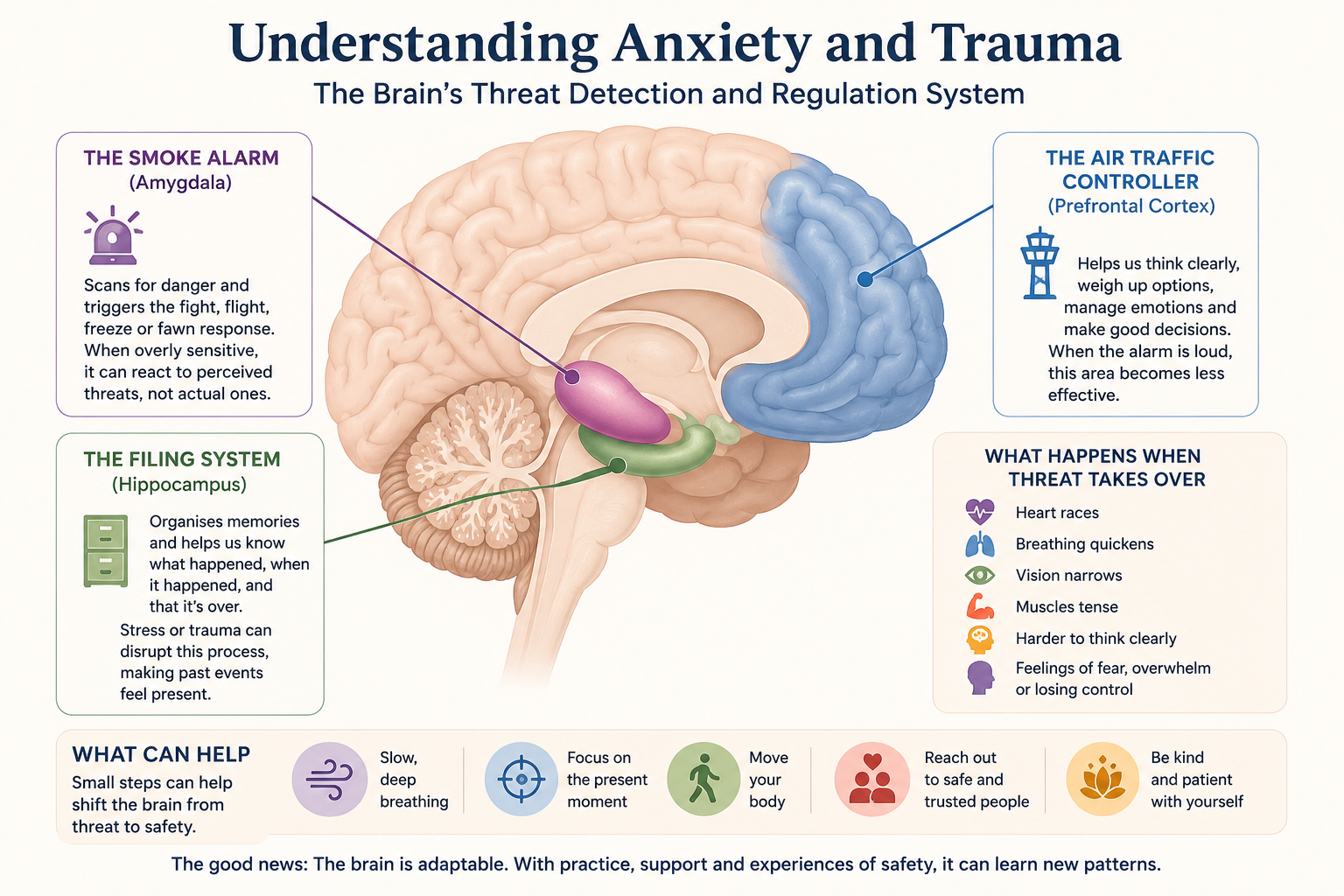
So you’ve got that big promotion conversation coming up, your child’s school teacher needs to speak to you about something, or you’ve been reminded of something unpleasant from the past. A few things might start to happen:
Your heart starts pounding
Your breathing becomes shallow and fast
Your vision narrows
Your hands feel clammy
Your face heats up
It feels like everyone is watching you or judging you
You might feel like you’re losing control
These are common signs that your brain’s threat detection system has shifted into high gear. While they can feel frightening, they’re actually the result of a sophisticated survival system trying to protect you. When we understand why this happens, it becomes easier to take small steps to reclaim control and take charge.
The smoke alarm, the air traffic controller, and the filing system
There are 3 parts of the brain that play a huge role in the anxious feelings we have when we remember something traumatic or we have something stressful coming up:
The smoke alarm (the amygdala)
The prefrontal cortex (the air traffic controller)
The hippocampus (the filing system)
The smoke alarm
The amygdala is part of an evolutionarily ancient network involved in detecting and responding to potential threats. The function of the amygdala is to serve as a smoke alarm, similar to the smoke alarm in your house. A smoke alarm detects a threat (smoke), and makes quite a racket to get your attention so you can move to safety.
The amygdala does the same thing: it scans for threats and, it it detects something, sounds the alarm to get your attention. In doing so, it gets your heart pumping faster to send freshly oxygenated blood to your muscles to fight off an attacker or run away from one (this is the “fight or flight” response you might’ve heard of before).
But sometimes your smoke alarm is too sensitive and it goes off while you’re just cooking toast, even when there’s no real danger.
If we have experienced a significant trauma or we experience ongoing stressors, our amygdala can become sensitive, and it can set our whole fight or flight response off in response to a perceived threat, instead of an actual threat.
The air traffic controller
The air traffic controller refers to our prefrontal cortex, right at the front of our brains just behind our forehead. This is a unique part of the brain for humans and intelligent animals because this is where our advanced problem-solving and logical thinking occurs. It integrates information from different parts of the brain, keep track of context (like time and place) and helps us plan, prioritise, and solve problems.
But, it’s hard for the prefrontal cortex and the amygdala to be active at the same time. When the amygdala detects danger, activity in the prefrontal cortex becomes less effective. That’s one reason it’s harder to think clearly, solve problems or make balanced decisions when we’re highly anxious. The amygdala responds to perceived threat without clearly distinguishing between something happening now and something that resembles a past danger.
The key there, is to try and turn the prefrontal cortex back on to help us manage anxiety and activated trauma.
The filing system
The last structure I want to tell you about is the hippocampus.
The hippocampus acts like the brain’s filing system. It helps organise memories by answering questions like “when did this happen?” and “is this happening now or is this something from the past?” During highly stressful or traumatic experiences, this process can become disrupted. Later, reminders of the event can make it feel as though the danger is happening again, even when you are safe.
The good news is that our brains remain adaptable throughout life. This ability, known as neuroplasticity, means that while anxiety and trauma can shape how the brain responds to threat, they do not have to define us. With practice, support and repeated experiences of safety, the brain can learn new patterns.
What can you do about it
Now, anxiety is not inherently bad. It’s one of the primary reasons we have survived so long as a species – it serves to keep us safe.
But when anxiety is taking the lead, one of the first things we can do is:
Slow down. Take long, deep breaths (anxiety tries to make you take short, fast breaths). This helps engage the prefrontal cortex, which can signal to the amygdala that there is no immediate danger.
Bring yourself into the present moment. Anxiety often pulls us into “what if?” while trauma can pull us back into “what happened then.” One way to help your brain recognise safety is to gently anchor yourself in the present: notice five things you can see, four things you can feel, or the sensation of your feet on the floor. These grounding techniques help reconnect the thinking brain with what is happening right now.
Move your body. I described the fight or flight system above. This creates energy in your body that needs to go somewhere. Moving your body helps complete the stress response and reduce physical tension.
Reach out. Relationships with people who are safe and trusted can be incredibly powerful. In the immediate aftermath of trauma, people don’t always need professional support. Often, simple human kindness like a blanket, a cup of tea, and a safe, calm environment can be profoundly regulating.
Anxiety and trauma responses are not signs of weakness. They are signs your brain has been working hard to keep you safe. The encouraging news is that our brains are capable of change. Through small, consistent practices and, when needed, professional support, we can strengthen the brain’s ability to recognise safety, regulate our emotions, and reclaim control.
Written by Dr Daniel Zuj (Psychologist)